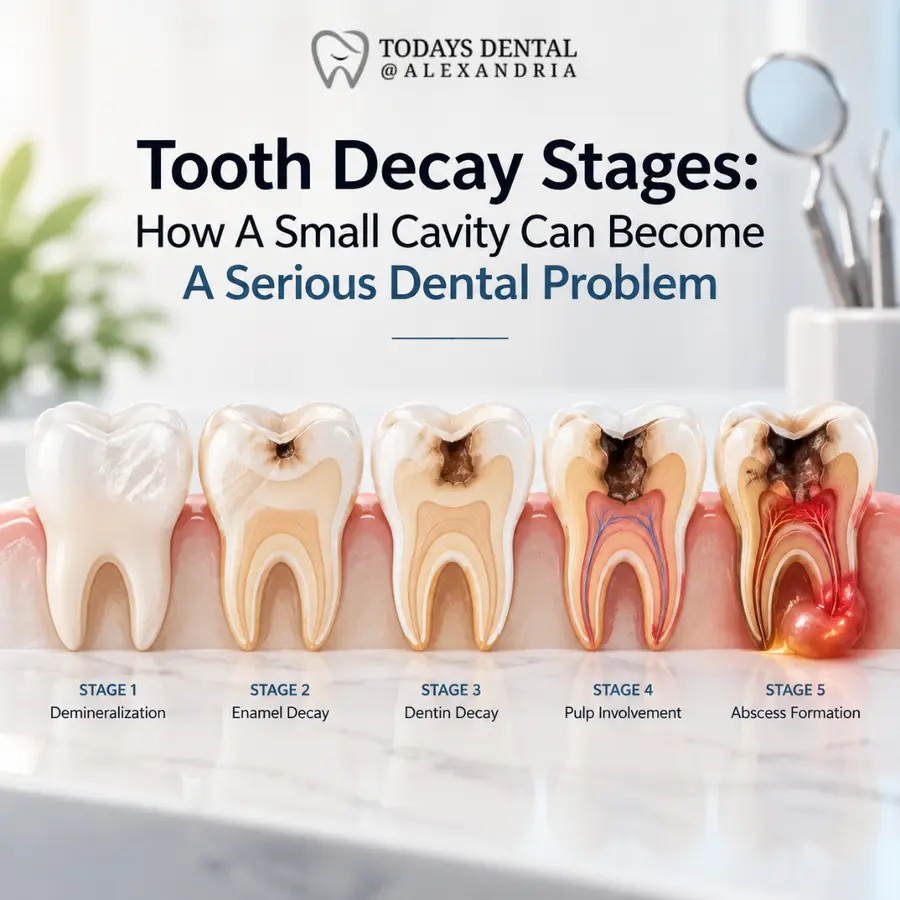
Many people find a small cavity and do not act right away. They feel no pain and think the problem will go away. A tiny spot can grow into a bad infection.
Tooth decay starts when mouth bacteria make acids that eat away the enamel. It first shows as white spots on the tooth.
Tooth decay develops in clear steps, and each stage causes more harm to dental health. Learning about these stages can help people spot problems early and seek timely treatment.
A dentist with clinical experience notes that bacteria in plaque produce acids that attack enamel. Acid removes minerals from the tooth surface. White spots appear as the first visible sign. The enamel gets weaker and more porous. Small cavities can grow larger over time as decay progresses.
Clinicians call this phase demineralization, the first of five main stages in the cavity lifecycle. Early damage may not cause pain, so patients often miss it. The spot can change from white to light brown as decay advances. Tiny openings can form and later lead to toothache, infection, or tooth loss if untreated.
Following Stage 1, where demineralization occurs, tooth decay continues into Stage 2: Enamel Decay. At this stage, bacteria attack the tooth's surface enamel more aggressively. The enamel has already weakened from acid exposure in the mouth. Small white spots typically appear first on the teeth as signs of early decay. These spots indicate that minerals have been lost.
As decay progresses, these white spots darken to light brown and eventually become darker shades. Areas of tooth decay may develop tiny openings or holes. This can lead to serious issues like a painful toothache or infection later on.
Early detection remains crucial; addressing enamel decay promptly can prevent it from advancing further and requiring complex treatments like fillings or root canals later on.
Dentin decay occurs after enamel has weakened. At this stage, the bacteria reach deeper layers of the tooth. Small cavities develop into larger ones, causing more damage. Initially, a person may not feel pain. This lack of discomfort can mislead them about the seriousness of their cavity.
Dark spots often appear as the decay progresses toward dentin. A person might first notice light brown patches on their teeth. As time goes by, these discolorations darken and create tiny openings or holes in the tooth structure.
Sensitivity to hot and cold food increases during this stage due to nerve exposure from decay progression. Ignoring treatment now could lead to serious issues like infection and significant toothaches later on if left untreated.
Moving from Stage 3, pulp involvement marks a severe progression in tooth decay. At this stage, bacteria invade the innermost part of the tooth, known as the pulp. The pulp contains nerves and blood vessels that keep teeth healthy. When bacteria reach this area, they can cause significant pain and sensitivity.
Infection may also occur within the pulp. This leads to a toothache that can worsen over time. If untreated, it can result in further complications like abscess formation. Ignoring early signs of decay allows it to advance unchecked; timely treatment is crucial at this stage to protect dental health and prevent serious problems down the line.
Abscess formation marks the final stage of tooth decay. As bacteria invade deeper into the tooth, they can reach the pulp. This causes an infection that leads to painful swelling and pus collection at the root tip. A small cavity may not hurt much initially, but neglecting treatment allows these issues to worsen. Without intervention, severe pain and even tooth loss can result from an abscess.
Treatment for an abscess often requires more than just a filling. Dentists might perform a root canal to remove infected tissue or prescribe antibiotics to clear up infection. Overlooking symptoms like sensitivity or throbbing pain only makes matters worse. Addressing cavities early is essential in preventing this serious dental problem from arising and safeguarding overall dental health.
Delaying treatment can lead to serious consequences for tooth decay. A small cavity often starts as a minor issue, quickly turning into a larger problem if neglected. Bacteria produce acids that attack the enamel, creating tiny openings in the tooth's surface. Over time, these openings expand and deepen, leading to more extensive damage and discomfort.
Ignoring early signs of decay allows bacteria to invade deeper layers of the tooth. The progression moves from weak enamel to dentin decay and then pulp involvement; each stage increases the risk of infection and tooth loss.
Personal experience shows that untreated cavities can evolve into painful conditions like abscesses or severe sensitivity where even hot or cold foods trigger discomfort. Early detection and prompt treatment are essential for maintaining good dental health before simple fillings turn into complex procedures like root canals.
Early action keeps a small cavity from becoming a serious problem.
| Treatment | What it treats | How it works |
|---|---|---|
| Fluoride Therapy | Stage 1, weakened enamel | Fluoride helps rehardening. It reverses early white spots. It stops acid made by oral bacteria from worsening enamel. |
| Silver Diamine Fluoride (SDF) | Early cavities and stalled decay | SDF arrests decay. It darkens decayed areas to prevent spread. It works when fillings are not yet placed. |
| Composite Fillings | Stage 2 and small Stage 3 cavities | Tooth decay is removed. Resin fills the tiny openings that formed. The filling restores function and shape. |
| Indirect Onlay or Crown | Large cavities and damaged enamel | Crowns cover weakened tooth structure. They stop further enamel and dentin loss. Ceramic options match tooth color. |
| Pulp Capping | Early pulp exposure risk | A medicated dressing protects the pulp. The pulp tries to heal if infection has not reached it. This can prevent root canal treatment. |
| Root Canal Therapy | Stage 4, pulp involvement | The infected pulp is removed. Canals are cleaned and sealed. Treatment ends severe toothache and infection risk. |
| Antibiotics and Drainage | Stage 5, abscess formation | Antibiotics control the spread of infection. Drainage removes pus from an abscess. These steps protect surrounding bone and tissue. |
| Extraction and Implant | Advanced decay with nonrestorable tooth | Extraction removes a hopeless tooth. An implant replaces the tooth long term. This prevents further bone loss and tooth loss. |
| Minimally Invasive Laser Care | Early to moderate cavities | Lasers remove decay with precision. They preserve more healthy enamel and dentin. They can reduce pain and bleeding. |
| Regular Exams and X-Rays | All stages, early detection | X-rays reveal decay under enamel and between teeth. Exams spot the white spots that mark Stage 1. Early care prevents progression through the five stages. |
Fillings work well for enamel and dentin decay, but they need proper placement and care. Root canal treatment can save teeth with pulp involvement, yet it requires follow up and restoration. Extraction removes infection but sacrifices the tooth. Modern restorations are less invasive than older crowns, while cost and access vary. Preventive care and regular exams remain the cheapest way to stop Stage 1 from ever becoming Stage 5.
Tooth decay has several stages. It starts with demineralization, where minerals leave the enamel. Next, a cavity forms in the enamel layer. If untreated, it can reach deeper layers and cause pain or infection.
A small cavity can grow larger over time if not treated. Bacteria can spread beyond the enamel to the dentin and pulp, leading to severe pain or even tooth loss.
Tooth decay is caused by plaque buildup on teeth. Sugars from food feed bacteria in plaque, which produce acid that harms tooth structure.
You can prevent cavities by practicing good oral hygiene like brushing twice daily and flossing regularly. Regular dental check-ups help catch issues early before they worsen into serious problems.
Tell us a little about what you need — we'll be in touch shortly.
4601 Pinecrest Office Park Dr Ste D, Alexandria, VA 22312, USA

Hi! I'm Tooth fairy! Your AI Assistant Ask me anything